In a 2023 audit of U.S. Customs and Border Protection, inspectors physically inventoried firearms across 12 locations and identified 126 firearms that were not located at the address recorded in the agency’s system of record. The audit also found weaknesses in ammunition accountability and storage-facility monitoring.
Shift change. Forty officers in line, twelve minutes to get weapons issued before deployment. The armorer is hand-checking serial numbers against a paper log, and the line isn’t moving. Multiply that by every shift, every day, across every facility an organization runs – and you have the real cost of manual armory management: not just inefficiency, but the audit gaps and compliance exposure that show up the moment an investigator asks “who had custody of this weapon on that date?”
That’s the problem digital armory management systems were built to solve. IoTWeaponTracker has designed and deployed them since 2007, working with military, law enforcement, and security organizations that can’t afford to get this wrong. Below is the operational framework we’ve seen separate the armories that run invisibly from the ones that generate incident reports.
What “Accountability” Actually Means in an Armory

Every armory management program either be it digital or manual, it’s measured against three questions:
- What weapons, gear, and ammunition does the organization possess?
- Where is each item right now?
- Who currently has custody of it?
Manual systems can answer these questions. They just can’t answer them reliably, instantly, or at volume – and those three qualifiers are where compliance failures live. A digital armory management platform answers all three in real time, regardless of shift volume or how many facilities are involved, provided the organization commits to two disciplines: logging every transaction digitally, and auditing regularly to confirm the digital record still matches physical reality. Software alone doesn’t produce accountability, but enforced process does.
Fixing the Shift-Change Bottleneck

The highest-friction moment in daily armory operations is the issue/return cycle during shift change, when manual approaches like use of paper logs, visual ID checks, hand-entered serial numbers. This create exactly the kind of bottleneck and error rate described above.
Digital systems replace that with automated, RFID-driven transactions:
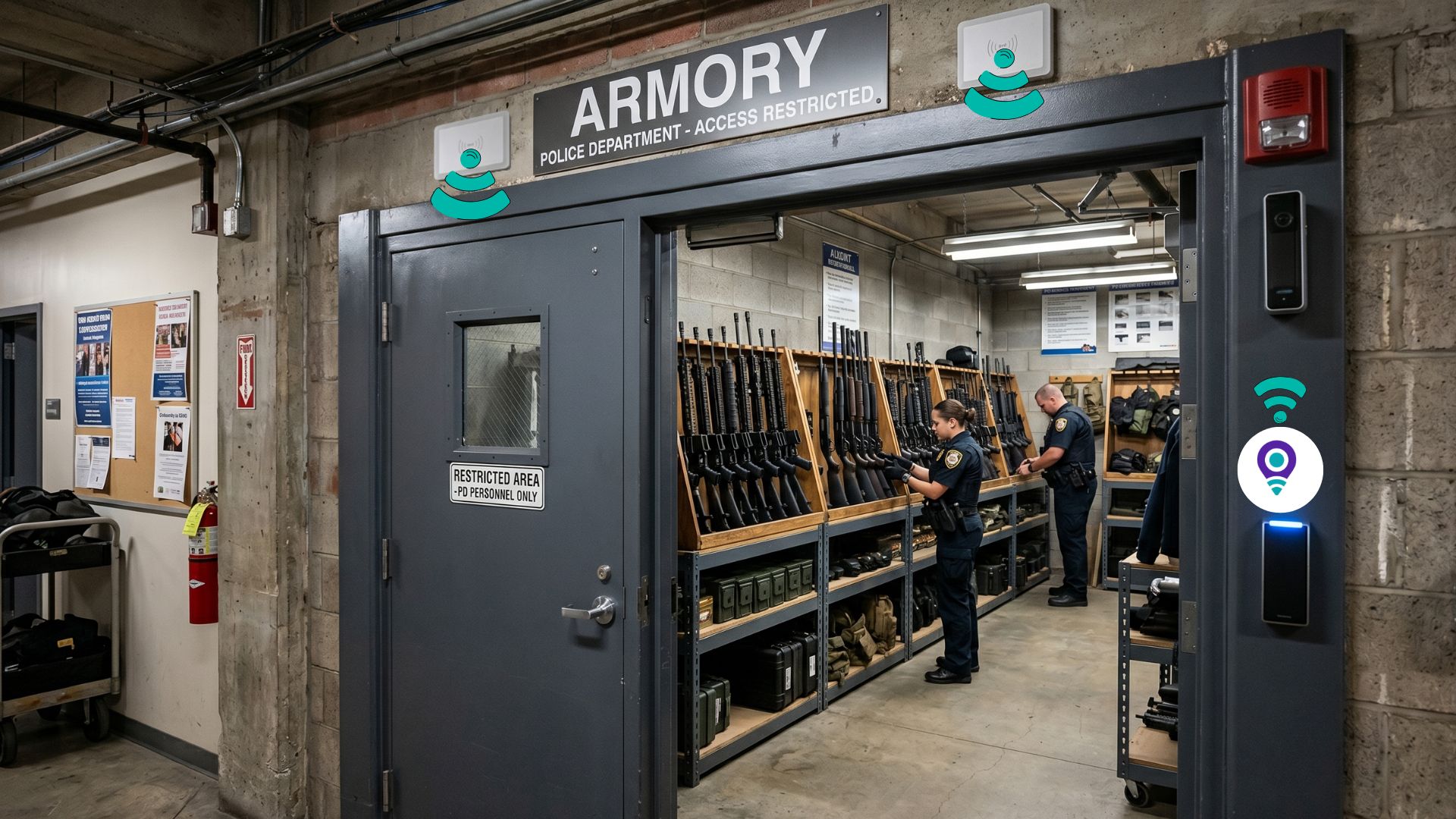
- Fixed RFID antennas at issue/return windows detect weapons as they pass, logging the transaction without manual entry.
- Automatic assignment lookup shows the armorer exactly what gear each authenticated officer is cleared for, and there is no need for manual verification under time pressure.
- Electronic signature capture confirms custody transfer in seconds, producing a chain-of-custody record that holds up under audit, without slowing the line.
The result isn’t just faster shift changes – it’s a transaction log that’s accurate because it was captured automatically, not typed in after the fact.
Running Armory Operations Across Multiple Facilities
Multi-site organizations face a problem single-facility armories don’t: how to keep centralized oversight without forcing every routine transaction through headquarters approval.
IoTWeaponTracker’s architecture resolves that tension by design:
- A central command dashboard shows real-time inventory, personnel readiness, and alerts across every facility at once.
- Local armorers manage day-to-day transactions autonomously, without waiting on central authorization.
- Cross-facility transfers move through integrated workflows that keep the chain of custody unbroken during the transfer itself.
Centralized visibility, with distributed control are the two capabilities most manual multi-site programs are forced to trade off against each other.
Maintenance Isn’t Optional – Automate the Schedule

An unmaintained weapon is both a safety risk to the officer carrying it and a compliance gap for the organization that issued it. Tracking maintenance due dates by hand across a few hundred weapons is where manual systems reliably break down.
Digital platforms remove the guesswork:
- Automatic monitoring of every weapon’s maintenance due date, with alerts sent before a task goes overdue — not after.
- Full digital records of every service event: technician, parts used, test-fire and inspection results.
- Instant retrieval of a weapon’s complete maintenance history the moment an investigator or auditor asks for it.
Technology Doesn’t Replace Training – It Needs It
A platform is only as good as the procedures built around it. The organizations with the strongest armory management performance pair the software with clearly documented standard operating procedures covering every transaction type: issuance, return, personnel authentication, maintenance scheduling, auditing, transfers, and incident reporting.
IoTWeaponTracker builds SOP development into every deployment: we work with your armory staff to document existing procedures, close gaps, configure the system to enforce them, and train every user group — armorers, administrators, commanding officers — to full proficiency before go-live.
How Much Time Could Your Armory Save?
How much time is your armory spending on manual transactions?
Manual issue and return processes don’t just create paperwork. They consume staff time every time an officer enters or leaves the armory. Use the calculator to estimate the annual operational time consumed by your current issue and return process.
spent processing manual armory issue and return transactions.
See Armory Management in Action
From manual transactions to automated accountability
See how a modern digital armory management system can connect weapon identification, personnel authentication, issue/return transactions and centralized accountability.
The Bottom Line
Armory management excellence comes from three things working together: the right technology, disciplined process, and trained people. Organizations that invest in all three get audit-ready accountability and fewer shift-change delays. Organizations relying on paper logs and ad hoc procedures will keep absorbing the errors and compliance exposure that come with them.

About Author
Eric Collins has been designing and delivering tracking systems since the 1980’s, and led the development of one of the industry’s first digital, computerized armory management systems in 2007. The initial iteration of the armory management system was developed for the U.S. Department of State for tracking all weapons, gear and ammo issued to embassies and agents worldwide, and the solution has continually evolved based on the requirements of military and law enforcement organizations globally. The armory management system includes rapidly configurable software that is configured for each customers exacting requirements, including integration with barcode, RFID (radio wave) and security devices. Most recently, Eric co-developed one of the industry’s first GPS-GSM real-time weapon tags, including alerts if geo-fence breach, weapon unholstered, weapon separated from officer or shots fired.